Silica Gel was invented in 1919, but its use as a desiccant became more common after World War II, when it was used to dehydrate pharmaceutical supplies. Silica gel containing hygroscopic salts such as calcium chloride and perchlorates performed exceptionally well in pharmaceutical applications. Because of their excellent absorption potential at various RH, the global competitive requirements of Silica Gel to satisfy Pharmaceutical applications are rising by the day. If the relative humidity rises, the desiccant's adsorption potential rises as well. As a result, it is the method of choice for pharmaceutical formulations and purifications in Analytical Techniques.
ChemBro & BhavNil have the answer to where to buy Silica gel in terms of requirements and costs. Globally, the market for Silica Gel Adsorbents in Healthcare Pharmaceutical applications is expected to rise, resulting in an increase in production volume.
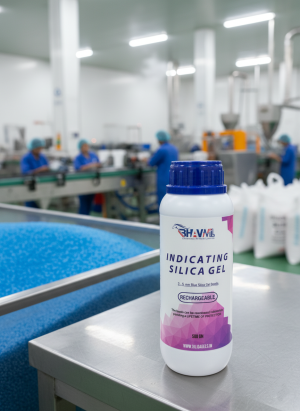
ChemBro & BhavNil is one of the Silica Gel manufacturers in India, supplying it on a large and small scale, focused on quality assurance and performance requirements, to Industrial Units pertaining to Healthcare and much more. It is obtained on a small scale by Sachets, which range in size from 0.25 grammes to 250 kilogrammes. Owing to the impregnation of markers such as methyl orange and cobalt chloride, these Silica gel sachets in bead form are also available in coloured variants such as blue and orange.
The type of indicating silica gel includes orange and blue silica gel. The saturation levels of the Silica gel are shown by the alteration in the colour of the beads in the sachet. It can be regenerated at a lower temperature of 120 degrees Celsius after it has reached its highest saturation level.
As a matter of concern, such as-Silica gel where to buy is undoubtedly resolved by ChemBro & BhavNil, which attributes to handle a wide range of varieties including bead forms and crystal forms in colourless as well as in Color forms along with their specifications like a range of size for both bead and crystal forms, Adsorption capacities of each on variations in relative humidity, composition, bulk density and many more.
Contaminants in pharmaceutical preparations can be detected and purified using a range of methods, including chromatography techniques including anion-exchange chromatography and size-exclusion chromatography. Anion-exchange chromatography has proved to be a successful analytical method for ensuring the safety of pharmaceutical preparations. Chromatography applications in the pharmaceutical industry, on the other hand, rely heavily on the desiccant used, which has an effect on the purity of the sample. It is the most effective desiccant because it is made up of interconnected microscopic pores with an average surface area of 700 to 800 square centimetres per gramme. Desiccants are used in medicinal formulations not only for formulation but also to preserve the consistency and appearance of the drug. Desiccants are used in cosmetics as a Thixotropic agent and as a Flatting agent in coatings, in addition to pharmaceutical applications.
Silica Gel in Water helps to adsorb metal ions from water, making it effective for water separation and purification in pharmaceutical preparations. Open Column Chromatography is the safest method for large-scale preparations and purifications since it uses a spherical shape of Silica Gel as the packing medium in the column. Reverse-phase open column chromatography, on the other hand, is a cost-effective method for preparations and purifications. Reverse phase column chromatography with Silica gel as the packing material is used to prepare natural compounds, Vitamin E, metal-coordinated compounds, and acetol purification. Without the use of adsorption, metal-coordinated compounds are isolated. Because of its inertness to monoamines, it is an advanced cation exchanger in column chromatography, where it serves as a stationary step for monoamines as eluents.